






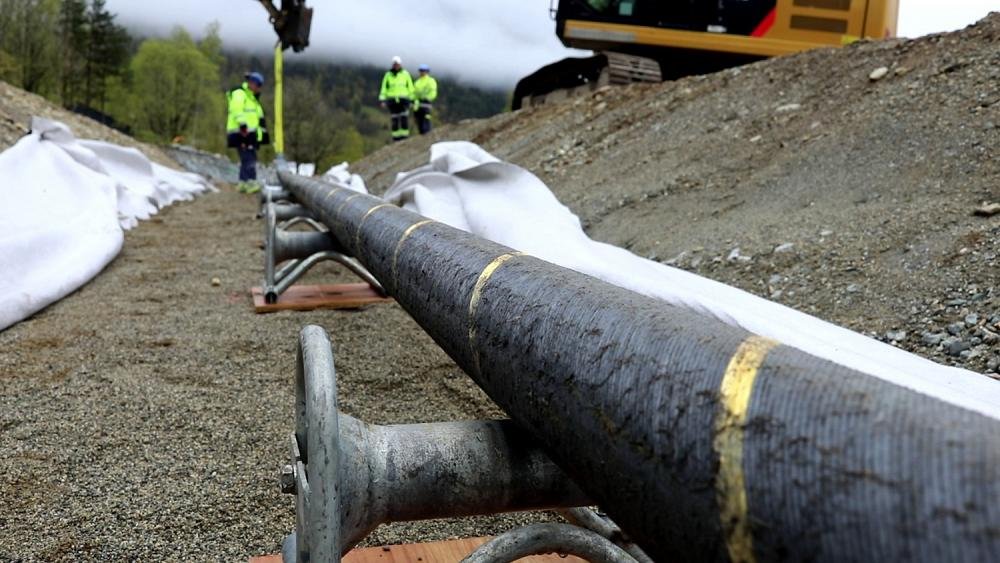
The globe” s lengthiest undersea power link was today activated, permitting Norway as well as the UK to share renewable resource.
The North Sea Web link ought to see the UK lower its carbon exhausts by 23 million tonnes by 2030.
The 720-kilometre cord links Blyth in Northumberland, in north-eastern England, to Kvilldall, a little town in south-western Norway.
It will originally have an optimum capability of 700 megawatts (MW) which will certainly be progressively boosted to get to 1,400 MW in concerning 3 months’ time.
The UK’s National Grid, which runs the interconnector in a joint endeavor with Norway’s Statnett system driver, stated in a declaration that as soon as at complete capability, the North Sea Web link ought to supply sufficient tidy power to power 1.4 million houses.
When wind generation in the UK will certainly be high however power need reduced, added sustainable power will certainly be exported from the UK to Norway as well as save water in Norway’s storage tanks, according to the declaration. Nevertheless, when need is high in the UK however wind generation is reduced, hydropower from Norway will certainly be imported.
Cordi O’Hara, Head Of State of National Grid Ventures, stated that it is “an amazing day for National Grid as well as a crucial action as we want to expand as well as decarbonise the UK’s power supply”.
” North Sea Web link is a really exceptional accomplishment of design. We needed to go via hills, arms as well as throughout the North Sea to make this take place. Yet as we anticipate COP26, Noth Sea Web link is likewise a wonderful instance of 2 nations interacting to increase renewable resource sources for shared advantage,” he included.
100 billion tonnes of carbon conserved
The interconnector took 6 years to finish at an expense of ₤ 1.6 billion (EUR1.9 billion).
It is the 5th interconnector to the National Grid as well as contributes to with web links to Belgium, France, as well as the Netherlands.
According to the National Grid, 90% of power imported through the interconnectors by 2030 will certainly be from zero-carbon resources that ought to conserve 100 million tonnes of carbon.
Statnett, on the other hand, runs a 2nd interconnector in between Norway as well as Germany, which browsed the web last winter season.
Regarding 98% of Norway’s power is produced from renewable resource resources with hydropower bookkeeping for 96% of the total amount, according to federal government data Wind power as well as thermal power ake up the continuing to be 2%.
A paper launched on Wednesday by the UK federal government revealed that throughout the initial 6 months of the year, nonrenewable fuel source represented a higher share of power generation than renewables.
The paper keeps in mind that sustainable generation lowered virtually 10% contrasted to the exact same duration in 2020 because of reduced typical wind rates as well as much less beneficial climate condition which affected both wind as well as solar manufacturing.


