




The Covering federal government’s collapse, the Taliban’s succeeding capture of Kabul, as well as terrible scenes of desertion at the resources’s airport terminal shell-shocked worldwide onlookers over the previous week.
Afghans sticking on a United States Flying force jet in a hopeless proposal to get away the nation shateringly advised the noticeable failings of expensive armed forces help as well as exterior treatment.
While the West contemplates over what failed as well as shuffles to leave nationals as well as their neighborhood assistants, countless Afghans are afraid for their lives as well as future in a repressive, Taliban-led routine.
Maybe unsurprisingly, a wave of intriguing stories has actually arised concerning exactly how America’s withdrawal associates with China’s future as an international power.
A Number Of these are misdirecting or downright oblivious. However 2 have actually obtained extra traction than others: (1) the suggestion that China will certainly relocate right into as well as manipulate any type of prospective power vacuum cleaner left by the United States in Afghanistan; as well as (2) that the United States withdrawal from Afghanistan indicates that Taiwan can not depend on United States help need to cross-strait connections transform (a lot more) sour. These final thoughts, nevertheless, are early as well as short-sighted.
Allow’s take on every one consequently. China was absolutely among the initial nations to show it would certainly acknowledge the Taliban as the brand-new federal government of Afghanistan. In a call with United States Assistant of State Anthony Blinken on Monday, Chinese Foreign Priest Wang Yi likewise reprimanded America’s document of “mechanically duplicating international designs” in traditionally as well as culturally various setups.
Chinese political numbers, state media as well as mediators have actually even more utilized this possibility to openly embarassment the United States’ document of “randomly conflicting in various other nations’ inner events”.
They say that the messed up nation-building job in Afghanistan identifies the colonial West from a relaxed China.
This might seem like a world power play– however truly it isn’t. As a matter of fact, China really sustained the “Battle on Fear”, albeit tacitly, as well as instrumentalised the political discussion of battling extremism to enhance the “3 Wickedness” (separatism, terrorism as well as spiritual extremism), which remain to notify as well as validate plan in Xinjiang today.
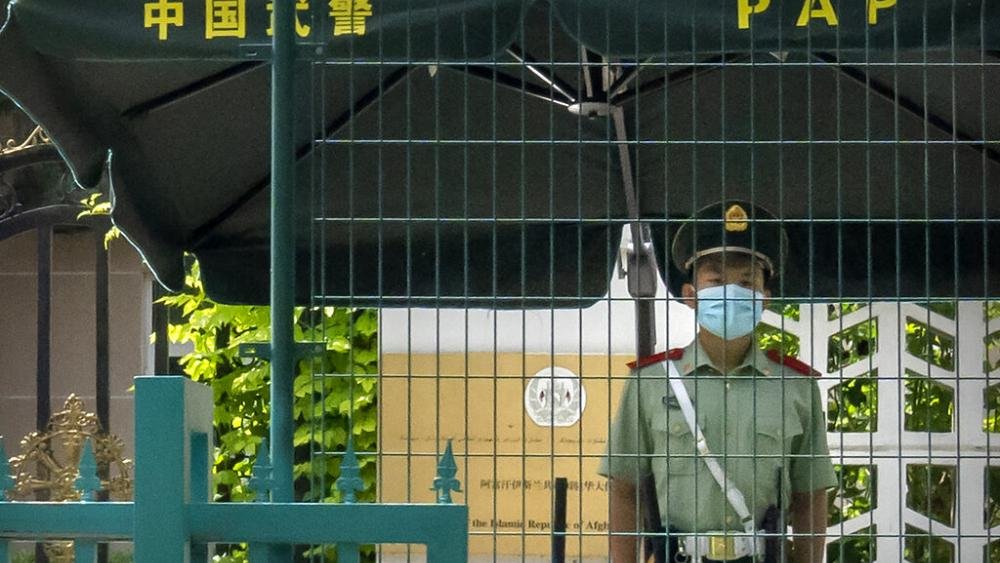
Beijing has actually as necessary looked for guarantees from the Taliban that the possibility for Uyghur separationist organisations to sprout within Afghanistan will not end up being a concern.
Onlookers appropriately keep in mind that Beijing might provide its best carrot– economic firepower– to draw out favours from the Taliban management by helping Afghanistan’s alarming financial circumstance.
Nonetheless, instead of a power grab by Beijing, this would certainly assist its prime goal of cultivating local security: neighbouring Pakistan, for example, is a cornerstone of China’s Belt as well as Roadway Effort as well as predicted prices for the China-Pakistan Economic Passage (CPEC), which was formally introduced in April 2015, have actually escalated to an approximated $62 billion.
Beijing is appropriately familiar with the threat that extremist teams posture to Chinese financial investments as well as nationals in the area.
Simply last April an automobile bomb in the southwestern Pakistani city of Quetta blew up in the parking lot of a resort in which the Chinese ambassador to Pakistan lived. While the ambassador was out the properties when the surge occurred, the Tehreek-e-Taliban Pakistan (TTP) took obligation for the strike, showing the dangers China encounters from Taliban procedures in the area.
Political resources is likewise on the line for China.
The last point Beijing desires is an extremely public safety and security case that requires a heavy-handed action, which, if the background of exterior disturbance in Afghanistan is anything to pass, would certainly be destined failing.
Exactly how Beijing browses tough safety and security worries around Afghanistan will certainly be a bellwether for its abroad safety and security approach somewhere else. The harmonizing act of resolving the defense of Chinese nationals as well as financial rate of interests with China’s long-proclaimed resistance to interventionist plans is absolutely not a very easy one. Simply put, the circumstance in Afghanistan is most definitely not a clear win however instead a migraine for a stability-seeking Beijing.
The withdrawal from Afghanistan is likewise extra intricate for China than merely an analogue for Taiwan. Without a doubt, the debate that the United States withdrawal from Afghanistan as well as the unquestionably not really prepared action to the Taliban requisition misbehaves information for Taipei since it signifies that the United States just gives safety and security if a concern drops within the remit of nationwide rate of interests, is realistically flawed.
Responding To China is, without a doubt, one of the most systematic goal of the Biden management. In addition, Taiwan inhabits a traditionally as well as diplomatically special setting in United States national politics as well as is a crucial goal people diplomacy. If the circumstance in Afghanistan need to suggest anything to Taiwanese policymakers, it’s that the United States significantly prioritises its abroad safety and security position in favour of East Asia. To say that subsiding United States rate of interests in safeguarding the Covering federal government from the Taliban has straight effects for Taiwan is to misinterpret America’s tactical reasoning. Besides, these specific rate of interests have actually resulted in a change in United States diplomacy in the direction of the Asia-Pacific as well as hence Taiwan to begin with.
China is hence neither likely to take advantage of the intended “power vacuum cleaner” in Afghanistan, neither needs to Afghanistan be taken a simple recommendation to analyze United States dedications in the direction of Taiwan. To do so likewise neglects the extremely actual altruistic dilemma which is still taking place on the ground in Afghanistan, in an effort to hair transplant the geopolitical value somewhere else.
The hidden factor for such short-sighted evaluations is conveniently located in the consistent unwillingness on component of a host of Western onlookers to acknowledge as well as value political sensations throughout the Global South in their very own right. Doing so first of all needs us to prevent mounting the Covering dilemma as a part of US-China competitors as well as acknowledge the intricacy of the circumstance handy. Besides, it is specifically the type of streamlined reasoning that has actually led the West to replicate our very own diplomacy calamities in the past by stopping working to value local as well as neighborhood national politics as well as backgrounds.
Lukas Fiala is an inbound PhD International Relations prospect at the London College of Business Economics as well as Task Planner of China Insight at LSE SUGGESTIONS. He is likewise a Yenching Scholar at Peking College as well as holds an MSc in International Relations from the LSE as well as a BSc in National Politics as well as International Relations from New University of the Liberal Arts, London.
Hugo Jones is an MSc International Relations prospect at LSE. He is Task Aide to LSE IDEAS China Insight.


