






The Greek island of Leros, in the Dodecanese, is known for its large natural harbour, imposing castle and picturesque villages.
But for about forty years the island was mainly known under a rather more negative epithet: “The Colony of Psychopaths”.
From 1958 to 1995, Leros was home to one of the largest psychiatric hospitals in Europe. In the ‘80s, a team of journalists and psychiatrists revealed the inhuman conditions under which the patients lived. UK broadsheet The Observer dubbed the facility ‘Europe’s guilty secret’ and the asylum soon closed.
Fast forward to 2021, and the spectre of detention still hangs over Leros.
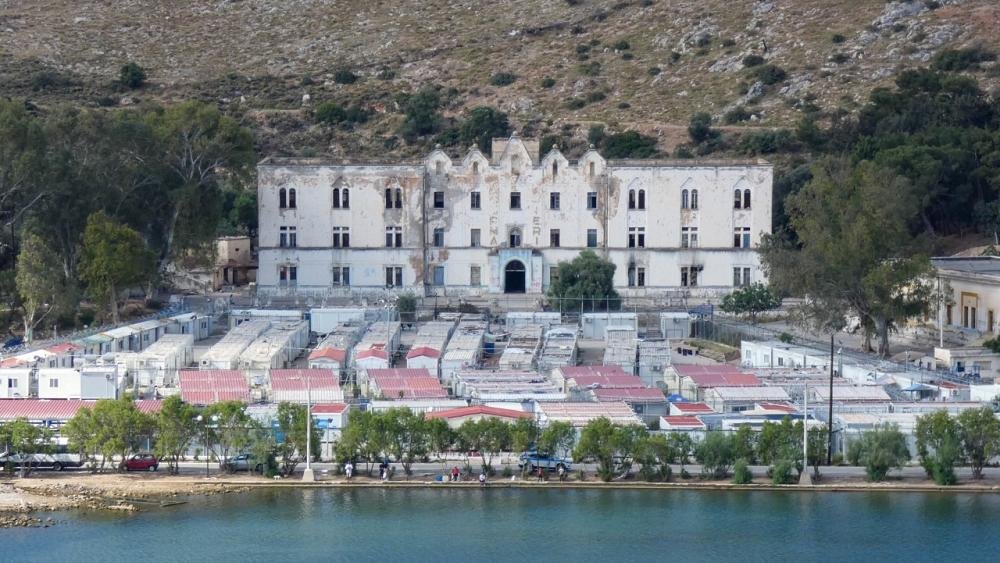
Around 200 asylum seekers live in prefabricated buildings with the grizzly facade of the abandoned hospital looming over them from the rear. But the Greek government is building a new closed detention centre that will accommodate up to ten times that amount. For many residents, the new facilities are a return to a past they hoped they had left behind.
Last January, the mayor appealed to the Greek Council of State against the decision to enlarge the capacity of what is termed as a ‘hotspot’. The hotspot initiative was launched in 2015 to stem and manage outsize migrant flows, and Leros was chosen as one of five. The other four being Kos, Lesvos, Chios and Samos.
“The island has a population of around 8,000. The water and electricity services could not bear the impact of another 2000 residents” Michalis Kolias, mayor of Leros, tells Euronews.
“Since the end of World War II, the island has in many ways been a detention centre. Today we want to focus on tourism, but we recognise that many residents benefited from the detention facilities in the sense that they worked there,” the mayor explains.
Italian occupation and Greek ‘gulags’
During the interwar period, Italy established a base for its Royal Navy in Leros and built a whole city in order to accommodate the military personnel and their families.
Since then, these Italian facilities have always been used as detention accommodation.
During the Greek civil war, the buildings were used to accommodate and “reeducate” the children of communists, while during the Greek Junta (1967-1974), around 4,000 political prisoners were exiled in a prison camp, or gulag, close to the hospital.
Signs of the Italian occupation are still evident in the buildings around the abandoned hospital. Some barracks bear Italian inscriptions, while a villa facing the sea is known as ‘Mussolini’s house’.
The history of the former psychiatric facility has heavily influenced the lives of the residents.
‘The hospital looked like a concentration camp’
Giorgos Ioannidis arrived in Leros in 1990, to work as a manager of the asylum: his aim was to reform the hospital, which had been overwhelmed by scandals. Since then, he has never left the island, and today he enjoys spending time in retirement in the cafés overlooking the port.
“When I arrived, the hospital looked like a concentration camp. More than a thousand patients were guarded naked by fishermen and shepherds, while only one psychiatrist worked in the centre,” Ioannidis tells Euronews.
“The island was economically dependent on the mental hospital since entire families worked there as guardians” Ioannidis explains.
Yet, when the Greek government considered closing the facility, residents chanted: “Hands off the mental hospital! Yes to its rehabilitation, no to its closure!”
“At the same time, the hospital’s terrible living conditions affected the locals working there. Leros was the island with the highest rate of alcoholism, and residents often robbed the hospital,” Ioannidis adds.
Today, for some locals, the new hotspot is a job opportunity. Many hope to work there as builders or guardians. At the same time, residents are not concerned that the new detention centre will affect tourism.
“The Greek government has said that it will be a closed centre, so tourists will hardly notice it,” a restaurateur in the port of Leros says.
Closed or not?
Several NGOs expressed concern about the new hotspots on these Greek islands. Although EU Commissioner Ylva Johansson insisted the new camps will “humane and not closed,” the Greek government described them as “closed and controlled”. They are expected to be ready by this summer.
For Matina Katsimbeli, a volunteer for the Leros Solidarity Network which provides aid to migrants, it’s hard to understand the government’s decision.
“The current hotspot can accommodate 800 people. Compared to last year, illegal border crossings in Greece have decreased by 80%. The number of migrants detained in hotspots has also decreased. Why does the government want to build a bigger centre?” Katsimbeli remarks.
Currently, ten Syrian families waiting for asylum are living in the hotspot in front of the abandoned hospital.
Many migrants spend the time fishing because they claim the food distributed in the hotspot is barely edible.
‘The waiting makes us crazy’
Nizar* is among the migrants waiting to be granted asylum. His first request was rejected. He fled Aleppo, where he worked as a policeman, with his family.
“Every now and then someone gets papers and leaves the island. It’s hard for those of us who remain. We are happy for our friends who managed to leave, but the waiting makes us crazy,” Nizar tells Euronews.
“Every time someone leaves the hotspot, my children look at me and say: why are they leaving, and we are not?” the asylum seeker says.
“I feel like the island of Leros is destined to bear the pain of exiles,” Katsimbeli tells Euronews. “All kinds of people the world wanted not to see have passed through here. And the violence of confinement continues to shape our lives”.
“Somehow, the spectre of history is still hanging over our island,” she laments.
*The real name has been changed to protect the identity


