






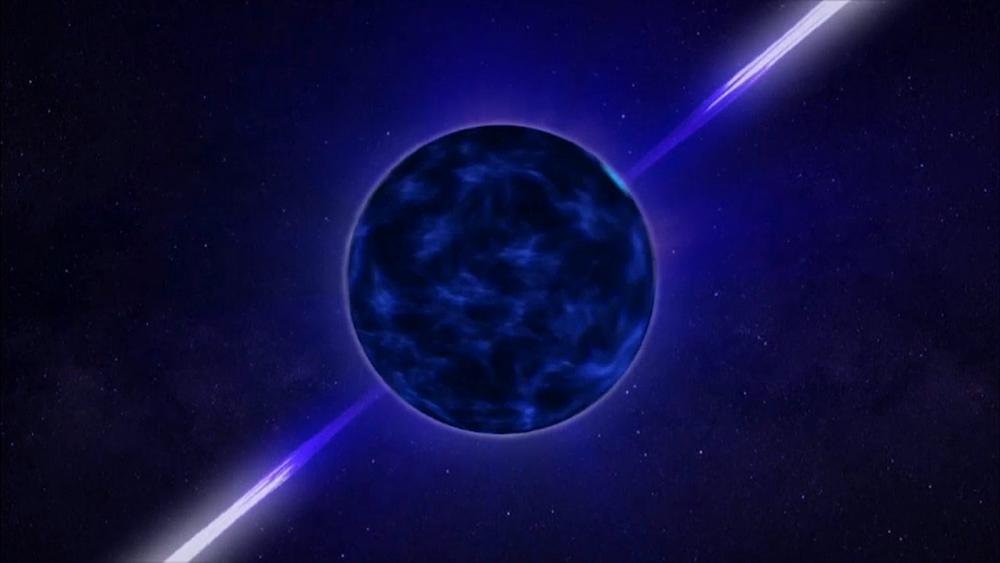
Scientists say, for the first time, they have worked out the size of the heaviest known neutron star.
A neutron star is what’s left over from an exploded star. It is incredibly dense but not dense enough to become a black hole.
The star is about 3,600 light years from Earth and is called ‘PSR J0740+6620’ or simply ‘J0740’ for short. It is more than twice our own Sun’s mass but it measures just 25 kilometres across.
Professor of Astrophysics at the University of Amsterdam, Anna Watts, is part of the team working on the research.
“A neutron star is a dead star,” she says. “So, neutron stars form when massive stars – so that would be something a little bit heavier than our Sun – reach the end of their lives and go supernova. And the cores of those stars then collapse in on themselves.
“And for the very heaviest stars, that collapse is absolutely unstoppable, and this produces black holes, from which nothing, not even light, can escape. Slightly lighter stars produce neutron stars, which are actually a bit more like tiny, ultra-dense planets. And they’re so dense that a teaspoon of neutron star material would weigh as much as Mount Everest.
J0740 was discovered in 2019 using the “Neutron star Interior Composition Explorer” or NICER x-ray telescope perched on the International Space Station and it challenges theories about what is at the heart of neutron stars.
Watts and her colleagues found that J0740 was actually not as small as they might have expected, thus challenging theories concerning the dense matter in the hearts of stars.
She describes it as being “less squashy.”
‘Not as small as expected’
“Some of the models that existed previously said actually, they could be pretty squashy. So, they could be pretty small, even when they contain a huge amount of matter. When we measured the star, we actually found it’s not as small as we might have expected.”
When a star dies it collapses under its own weight but researchers want to know why the heaviest ones become black holes and lighter ones turn into neutron stars.
Watts says: “This is a really hot topic right now because we have colleagues also doing analysis with gravitational waves, trying to come at this from a different direction and finding smaller and smaller black holes, and we’re trying to work out where the upper limit of neutron stars is. And at some point, there’s a line, beyond which something has to become a black hole.”
As the star dies it bursts into a supernova before becoming a neutron star and these scientists are also helping inform theories on what kind of cosmic oddities eventually become black holes.


